Money Dysmorphia: When Your Bank Account and Your Nervous System Tell Different Stories
Written By Topaz Shalgi, Intern
You check your bank account: your rent is paid, you have groceries for the month, and your savings are healthy. Logically, you know you’re not in immediate danger. Yet emotionally, it still doesn’t feel like enough.
This uncomfortable gap between financial reality and financial anxiety is known as money dysmorphia. ATB Financial defines it as the difference between “how your money feels” and “what your money truly says,” while clarifying that it’s not a clinical diagnosis. The term draws from body dysmorphia: in both, the perceived “flaw” isn’t rooted in objective reality, but in personal perception (Davies, 2025). For many Canadians, this fear is common. Nearly half have lost sleep over financial worries, and about one in three report being short of money by month’s end (The Financial Consumer Agency of Canada, 2025).

In this blog, we will explore why money can feel tied to safety, how scarcity mindset, hedonic adaptation, and social comparison intensify financial anxiety, and what steps can help us redefine what “enough” actually means.
As a university student, I’ve seen how easy it is to compare financial timelines. One of your friends may be traveling, someone in your program is investing, and someone you see around campus seems to have endless support from home. After considering all those stories, suddenly, your own progress can feel smaller than it truly is.

Money dysmorphia is not an official mental health diagnosis, but it gives a voice to a very real, underrepresented experience. It is not as simple as being “bad” or “good” with money, but rather, it’s more the emotional story attached to your money. Someone might have enough to pay for their basic needs, but still get anxious every time they hit the checkout. Someone might avoid looking at their bank accounts because they are afraid of what they may see. For others, it may look as though they are constantly comparing their lifestyle to those of people online and feeling like they will never catch up. What this feeling may look like from an outside perspective includes avoiding money decisions, feeling guilty about spending on things you want but don't need, comparing lifestyles, and delaying joy because you feel like you haven’t “earned” it yet (Davies, 2025).
According to Maslow’s hierarchy of needs, physiological needs such as food come first, followed by safety needs, which involve feeling secure, stable, and protected from threats (Britannica, 2026). One reason money dysmorphia can feel so intense is because money is inextricably linked to safety. When someone isn’t able to afford rent, food, transportation, or medication, the need for more money is not irrational; it is for their survival. However, even after someone has fulfilled their basic needs, money can still feel like protection against the unknown. You may already know how much rent costs and what your phone bill will look like, but you can’t predict how much money you may need to protect yourself from any possible emergency. This could include job loss, illness, repairs, or any unexpected event that may pop up. This is where the feeling of “enough” becomes difficult to define.

A great example of this can be Canada's current economic state. In the spring of 2024, Statistics Canada found that 45% of Canadians said rising prices were greatly affecting their ability to meet day-to-day expenses (Government of Canada, 2024). Since then, affordability has remained a major concern for many Canadians. When affordability feels uncertain, financial safety can start to feel like a moving target, pushing people to prepare for a future they cannot fully predict.
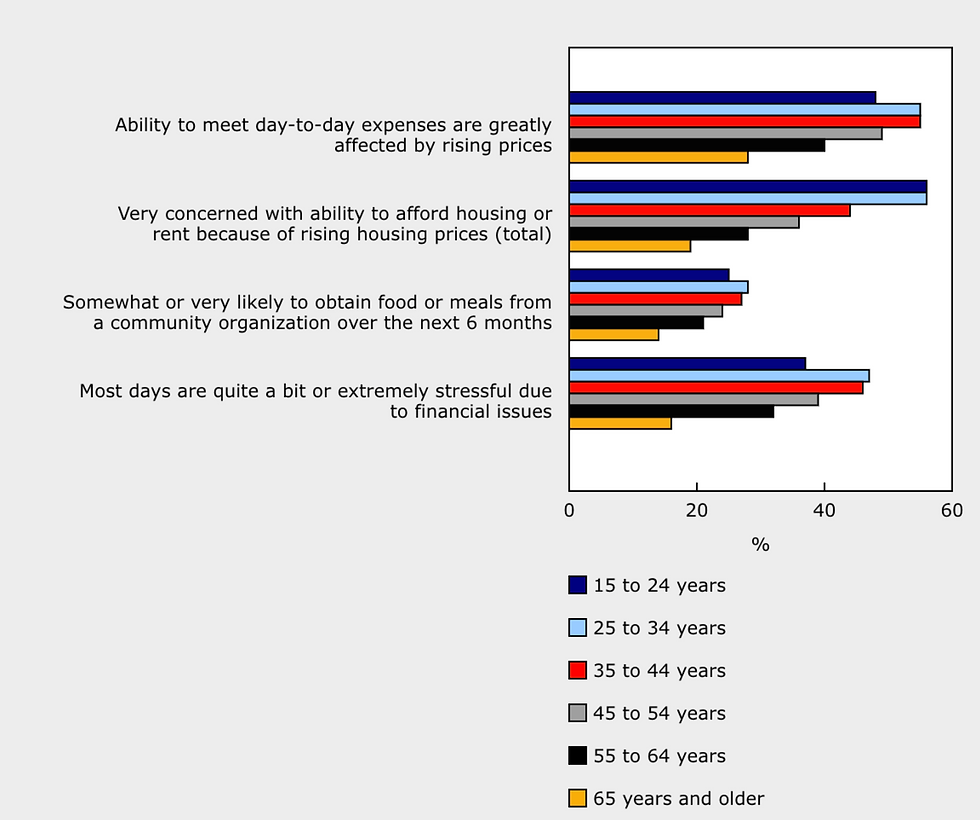
(Government of Canada, 2024)
While this may sound similar to someone just trying to save as much as possible, there is a difference between being financially responsible and feeling controlled by financial fear. Budgeting can be useful when the purpose is to give someone clarity and control. But when struggling with money dysmorphia, we tend to see the scarcity mindset take control.
The scarcity mindset is when every purchase feels dangerous, every bill feels threatening, and every possible problem feels like something you need to prepare for immediately. The issue here is not planning; it’s the panic that follows. This mindset can sometimes be shaped by past financial stress, instability, or difficult experiences with money and can make a person feel like they are always one decision away from financial disaster, even when the fear is not fully supported by the facts.
From a young adult perspective, this pressure can feel even heavier. University is expensive. It comes with all sorts of costs like tuition, rent, groceries, textbooks, transportation, and wanting to have fun with peers. As someone currently in this position, I think that this is where money dysmorphia can become especially complex. At times, the stress can be from real costs. Other times, it's purely from comparison and creating this narrative in your mind that whatever you do won’t prepare you as much as the person next to you seems to be. The Canadian Alliance of Student Associations supports this with their report on post-secondary students taking serious cost-cutting measures. Approximately 40% of the students are skipping meals, 31% aren’t buying textbooks, 24% are struggling to pay rent, and 19% are using food banks (Canadian Alliance of Student Associations, 2025).

(Canadian Alliance of Student Associations, 2025)
Something else that can help differentiate between healthy budgeting and being controlled by fear is the effect financial anxiety has on mental health. A Canadian study of 12,995 secondary school students found that 16.1% reported financial worry during the pandemic, and that financial worry was significantly associated with increased anxiety scores (Government of Canada, 2024). When your money feels like it's fleeting, the brain may start to treat everyday financial decisions as threats. So, since money feels like an inconsistent factor in your life, the brain will involuntarily respond as if safety is always just out of reach. Over time, this can affect sleep, focus, motivation, and emotional well-being.
Another reason money may never seem like enough is because of hedonic adaptation. Hedonic adaptation is when people adjust fairly quickly to the positive or negative changes happening in their lives (Magee, 2025). As people, we are always striving for something newer, bigger, or better. So, reaching a financial goal may feel exciting or relieving in the initial moment, but once time has passed, the mind will start to search for the next goal. For instance, a person may believe “I’ll feel secure once I save $1,000.” However, once they reach $1,000, they will change their goal to $1,500, then $2,000. It almost feels like your brain is promising to give you a break after you hit your next financial achievement, but once you make it there, it quietly changes it to something larger. While this seems responsible in theory, the emotional finish line becomes a moving target, making it almost impossible to get the final feeling of completion.
Relating back to student and young adult life, social comparison is also an essential variable when considering the strength of money dysmorphia. Especially in today's youth, our society loves to glamourize people's lifestyles through our screens. We see celebrities going to Coachella, people from our past becoming homeowners, our friends attending fancy dinners, wearing expensive outfits, or buying a new car. But, what we forget to consider as the viewer is what they don't show. They don’t mention their debt, family support, budgeting, stress, or trade-offs happening behind the scenes. In support of this, ATB Financial notes that money dysmorphia can be shaped by comparing your lifestyle to other people’s online highlights (Davies, 2025).

However, this comparison doesn’t end when you put your phone away. It also happens in the real world. When talking to people, they sometimes try to push the idea that their lives are perfect and aren’t transparent with their real issues. I once had someone at a golf course tell me that the clubs you buy can influence how seriously people take your game. That really stuck with me because it showed how quickly money can be tied to identity and the way people perceive you. In this situation, it is not just about the item itself, but rather what the item seems to represent: status, belonging, skill, or success. And from an outside standpoint, seeing someone with the best golf clubs, at the nicest golf course, talking about everything they have, it can make you feel minuscule in comparison.
While it is impossible to say that money does not matter, once your deeper issue is driven by fear, more money will not automatically create peace. For example, the TikTok creator Bradley on a Budget is frugal because of the student debt he took on from culinary school, which is a perfectly understandable reason to spend consciously (Wilshere, 2025). However, if we steer away from that and see that your motivation is rooted in comparison, anxiety, and the belief that financial disaster is always waiting, then there is an unhealthy mindset that has to be dealt with. Continuously trying to get more money will not heal the fear that teaches someone to feel unsafe with their finances in the first place.
There are numerous ways someone can take initiative and try to start healing their relationship with money. First is by doing reality-check-ins with your numbers. By avoiding your finances, it can make your fear grow larger than the reality in your bank account. Looking at income, expenses, savings, debt, and actual obligations can help separate real financial problems from imagined ones.
Second is defining what “enough” means for your actual life. The underlying issue of money dysmorphia is genuinely not understanding when enough is enough. People don’t tend to see the line between being sufficient and needing financial help. So when you get in that kind of situation, it is best to take a step back, relax, and ask yourself questions to help clarify how you truly feel in the moment. This can include…
“What do I need to cover my basic expenses?”
“What amount would make me feel prepared for one month?”
“What can I realistically save at this stage of life?”
“What can I spend on enjoyment without guilt?”
“Am I chasing safety, status, belonging, or control?”
After asking yourself these questions, you may notice that you forgot how to live in the moment rather than stressing over a potential future mishap.
Third is noticing the comparison triggers. If you see that certain apps, people, environments, or conversations make you feel financially insecure, notice it. It’s best to remind yourself to place boundaries in your life, and if you know something may upset you in the moment, you don’t have to deal with it right then and there. The goal is not to avoid comparison forever, but rather to recognize when the comparison is distorting your current reality.
Finally, one of the best ways to begin your healing journey is by asking for help. If money anxiety is affecting your sleep, school, relationships, or daily functioning in any way, it may be helpful to speak with somebody. This can include a clinical or financial therapist, financial coach, school financial wellness office, or any other trusted support system you may have.


Comments