Meet Sarah
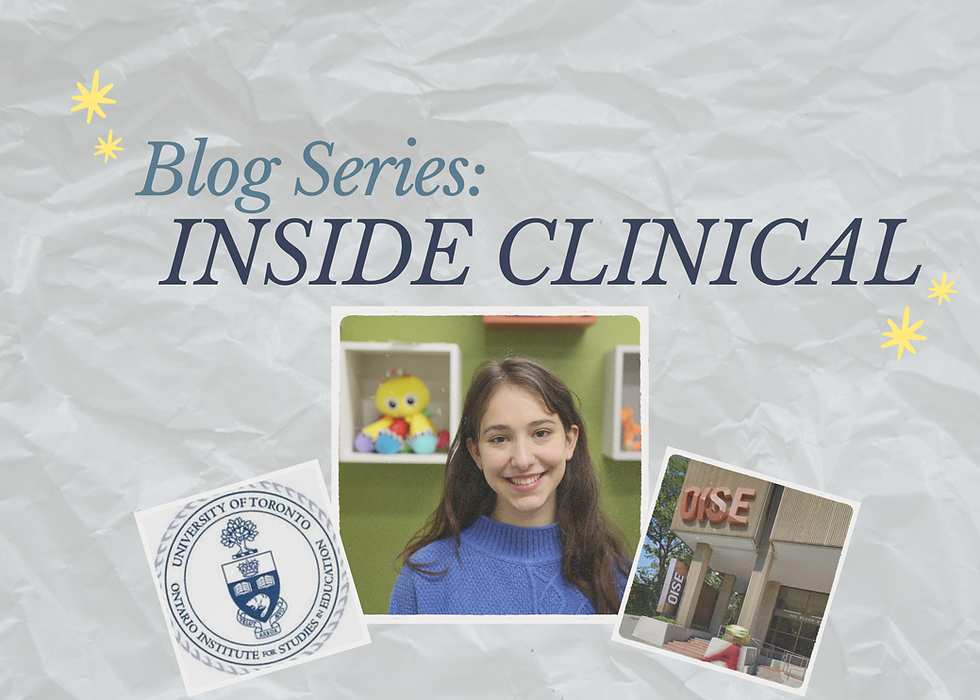
Our 9th guest in our Inside Clinical series is Sarah Kowall, a first-year Clinical Psychology graduate student at Toronto Metropolitan University (TMU). Sarah completed her undergraduate degree at the University of Winnipeg, a small institution with limited formal resources in clinical psychology. Despite these limitations, Sarah was able to carve her own path, seeking external research opportunities, advocating for herself, and building an impressive foundation across multiple labs. Sarah’s journey to TMU is a powerful testament to her persistence and determination.
From a young age, Sarah was surrounded by healthcare workers, constantly being exposed to discussions about patient care and mental health. Being in this environment Sarah knew she had a role to play in helping others, however it wasn’t until Sarah encountered her own mental health challenges in middle and high school where she found her place in clinical psychology.
Sarah was fortunate enough to begin gaining research experience after high school, where she took a research position in comparative cognition, training and studying pigeons. While this topic has nothing to do with her current work, which focuses on how mental health and stress can impact sexualized substance use over time, these pigeons solidified her decision in wanting to pursue research. They serve as a key component in her story to success. Even now Sarah jokes that she has a soft spot for pigeons!
Building a Path Without a Roadmap
Joining a clinical psychology graduate program is rarely a linear path and this is evident in Sarah’s journey from studying pigeons to researching sexual health. While attending a small institution gave Sarah the advantage of intimate class sizes and strong relationships with professors, it also meant navigating the graduate school process with very little guidance.
“I didn’t have a mentor to tell me what a CV should look like, or that I should contact potential supervisors, I had to figure all of that out on my own.”
Learning these skills independently is no simple task, and for Sarah, the process took four full application cycles before she earned her spot at Toronto Metropolitan University.
Cycle 1: Applied to 5 programs and received no interviews
Cycle 2: Applied to 10 programs, received one interview and one shortlist
Cycle 3: Applied to 13 programs, received two interviews and one shortlist
Cycle 4: Applied to 5 programs, received 5 interviews and four shortlists
In moments of rejection, Sarah credits her stubbornness and passion for keeping her moving forward. She refused to give up, despite well meaning mentors suggesting she consider plan B options.
“I was encouraged to consider other options, like a plan B. I was not happy about that. I was like, no, this is what I want to do.”
Looking back Sarah is grateful for every gap year she didn’t want.
“I gained experience that I never would've had otherwise. Those years made me a better researcher and better prepared for graduate school.”
Reframing Rejection into Opportunities for Growth
With each cycle, Sarah refined her strategy, strengthened her application, and grew both personally and professionally. During our conversation she revealed what she learnt and some of her key takeaways.
Contact supervisors ahead of time and properly
Reaching out to potential supervisors ahead of time is an important part of the application process. Early contact not only puts your name on their radar but also helps you confirm whether they have the capacity to take on new students that cycle. When sending these emails, keep your message concise. Briefly introduce yourself, highlight the key experiences or skills that make you a strong fit for their lab, and ask clear, purposeful questions. A well-crafted email can make a meaningful first impression.
Treat your letter of intent and CV differently
A strong letter of intent should not be a summary of your CV. Instead, it should highlight specific research experiences that demonstrate why you would be a valuable addition to the lab. Focus on how your background aligns with the supervisor’s work, propose realistic research ideas you could explore under their mentorship, and explain how your familiarity with various research methods is an asset to their ongoing projects.
Use your gap years strategically. Gap years can be incredibly valuable to deepen your research experience, develop new skills and strengthen your application. Seek out roles in different labs and work with a variety of mentors. If possible, aim to contribute to publications or conference presentations, these experiences not only enhance your CV but also prepare you for the demands of graduate level research.
“I was trying to use those years to build up my CV and gather experience. I worked in a few different labs, volunteered doing online counseling, signed up for conferences, got things published. Taking that time to really hone in on my research experience has definitely helped.”
Make a good impression on everyone
During the interview process, it’s important to remember that you’re not only being evaluated by potential supervisors, current graduate students also play a meaningful role. Supervisors often consult their students for feedback on applicants, and their impressions can influence final decisions. Beyond that, these are the peers you may one day collaborate with, learn from, and rely on throughout your graduate journey. Taking the time to build a genuine connection can contribute positively to your future experience.
Advice for Students Facing Rejection
Rejection doesn't mean that you aren't good enough.
“You might be a terrific applicant, it’s not that you’re not a good student and it’s not that you’re not doing the right things, it’s just that it didn’t work out that year.”
Focus on what you can control.
“I think it's important to focus on what you do have control over, which is the experience you’re getting.”
Don’t be afraid to take the time you need.
“One of two extra years of extra applications is nothing in the grand scheme of things.”
Build a strong support system.
“Just have a good support system too. Have people that are cheering you on, if you don’t get in, have people that you can rant to about it. It’s okay to be upset, it’s just about how you get back up and when you do it again.”
Overcoming Funding Obstacles
Securing funding is one of the most difficult aspects of pursuing graduate studies for many students, including Sarah.
“I mean it was super daunting for me. I'm like, my god, I've never had to fund anything in my life. Like, what is this going to consist of?”
Fortunately despite the initial stress, Sarah has a very successful funding history. She successfully secured the Canada Graduate Scholarship multiple times throughout her application cycles. To break it down, CGS is the main funding source for graduate programs across Canada, awarded through three different domains. Natural science, social sciences and health. Sarah received her funding through the Canadian Institute of Health Research.
Sarah emphasizes that funding committees are not looking for the perfect candidates, they are looking for potential. What Sarah found to be helpful when writing her research proposals was to find an idea that is novel and original, that it actually warrants funding. It’s important that you’re not repeating another study or reviewing one. Sarah stresses that not having publications is not the end all be all. Funding committees want to see that you have the potential to perform research. Committees want to see applicants who are well-rounded, balancing research, clinical experience, and community involvement. Including a CV that reflects this can make a meaningful difference
“Even when I didn’t have papers published, what was helpful was being well-rounded. Having lots of clinical experience, lots of research experience, community involvement. They want to see that you can do a bit of everything.”
Final Thoughts
Sarah’s journey is a reminder that the path to clinical psychology isn't defined by how quickly you get there, but by the resilience you bring along the way. For every student walking a similar path, her story serves as proof that determination truly pays off and that there is light at the end of the tunnel.
Sarah reminds everyone to be patient with yourself and appreciate every accomplishment.
“I think it’s important to recognize that you’re doing great, it’s a hard thing to be doing, and to not be too hard on yourself.”
“To be even applying for clinical psych is a huge accomplishment in itself. To even have an undergraduate degree with honours is fantastic, you’re doing great”




Comments